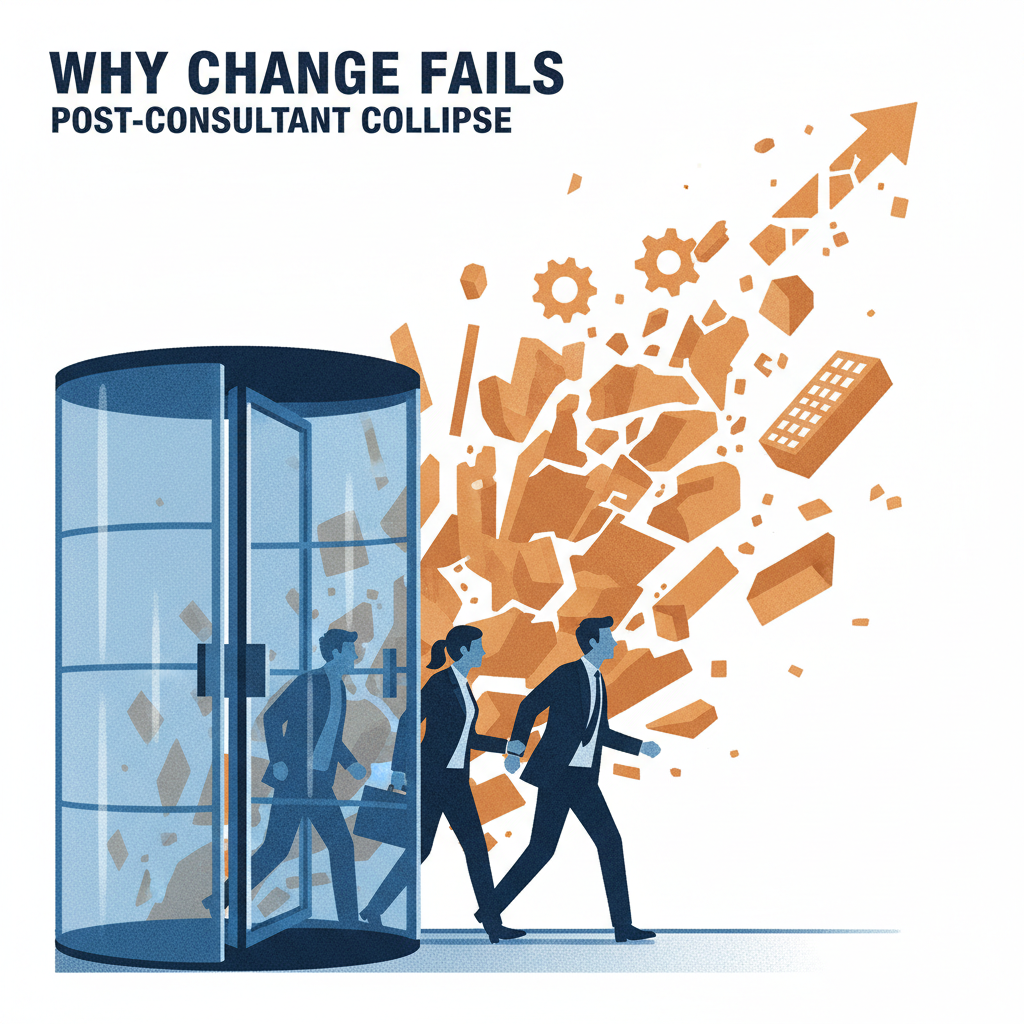
Organizational transformation is one of the largest and most persistent investment categories in business — and one of the most reliably disappointing in terms of sustained outcomes. The consulting industry has generated extensive analysis of why transformation initiatives fail. What receives comparatively less attention is a more specific and more common failure mode: the transformation that succeeds during the engagement and then quietly undoes itself over the following eighteen to twenty-four months.
This pattern is well known to anyone who has been on either side of a major change initiative. The external team arrives, brings clarity, structure, and momentum. Diagnosis is thorough. The new ways of working are implemented with competence and care. Results improve. And then the engagement ends, the external team departs, and the organization — which has not fundamentally changed its internal capability to sustain what was built — begins, gradually, to revert. Not because anyone decides to go backward, but because the conditions that would sustain the change were never fully established.
The root cause is a distinction that is easy to state and difficult to act on: the difference between change that is installed in an organization and change that is absorbed by it. Installed change means that new processes, new roles, new metrics, and new behaviors exist and function — while the external support is present. Absorbed change means the organization has developed the internal capacity, understanding, and ownership to sustain those behaviors independently, without the presence of the people who introduced them.
The installation is what most transformation investments fund. The absorption — the harder, slower work of building internal capability to understand, own, and evolve what was built — is typically underfunded and underdesigned. The result is organizations that are genuinely better during and immediately after the engagement, and gradually less better as the institutional scaffolding provided by the external team is removed.
A useful analogy is physical rehabilitation. A skilled physiotherapist can design and supervise a recovery program that produces real improvement in a patient's condition. But if the patient doesn't develop the understanding and discipline to maintain that condition independently — if they rely on the scheduled sessions without internalizing the underlying principles — the improvement will erode when the sessions end. The physiotherapist cannot generate permanent capability in the patient through proximity alone. Neither can an external consulting team generate permanent organizational capability through the quality of their deliverables alone.
This has practical implications for how organizations should evaluate and structure transformation investments. The right questions are not just "will this intervention produce the change we need?" but "will the organization be capable of maintaining and building on that change once the external support ends?" The answers require honest assessment of the internal organizational capabilities being developed during the engagement — not just the outputs being produced.
Organizations that manage this well tend to treat external partnerships differently. They use external expertise to develop internal capability, not as a substitute for it. They design engagements explicitly around the transfer of understanding rather than just the transfer of outputs. And they measure success not at the end of the engagement but twelve months after — when the evidence of organizational absorption, rather than installation, becomes visible.