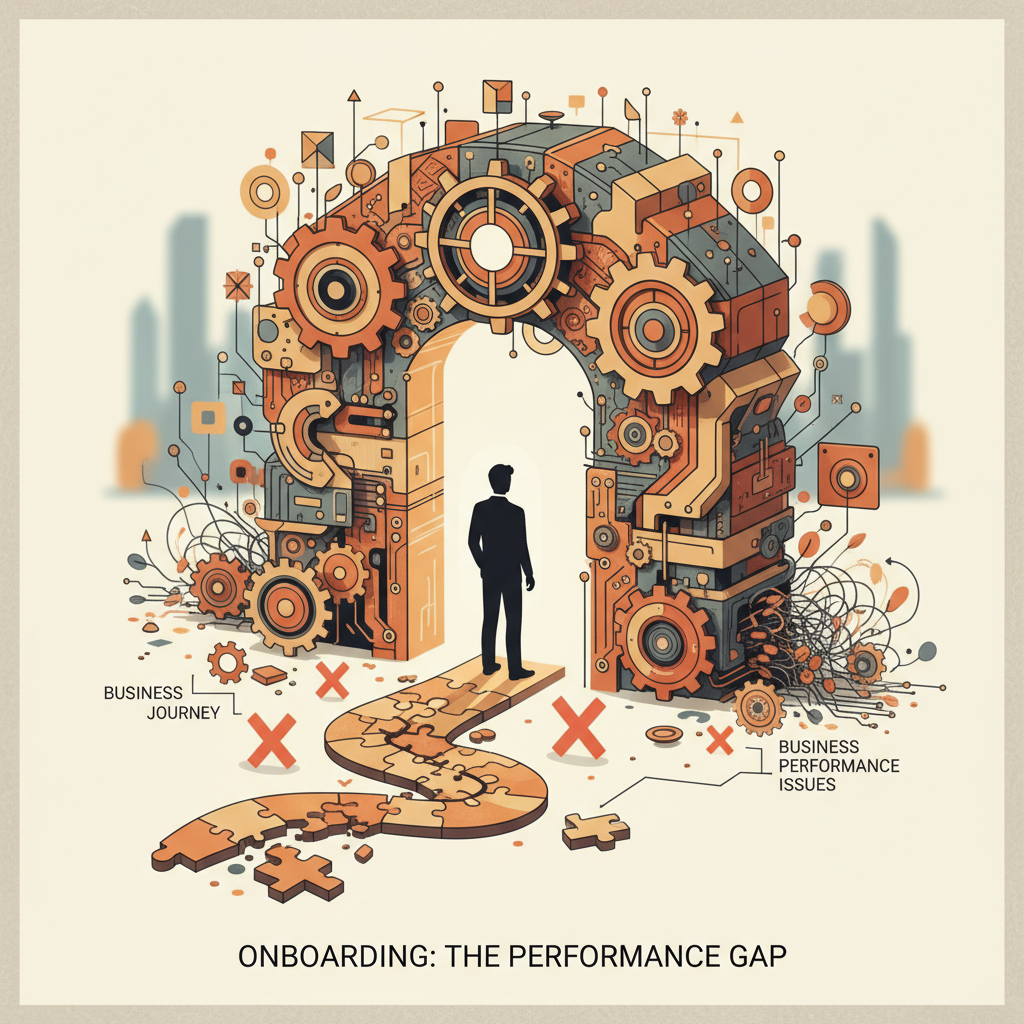
A company spends six months identifying, attracting, and selecting a senior hire. The process is deliberate, expensive, and carefully managed. Then the person joins — and for the first three to six months, their actual ability to contribute is largely governed by whatever the organization happens to do with them during onboarding. In most companies, that gap between investment in selection and investment in integration is enormous.
Onboarding is persistently underestimated because it is classified as an administrative process — the paperwork, the IT access, the introductory meetings — rather than as a strategic performance intervention. This classification error has real consequences. It means the function is resourced at the level of coordination rather than the level of organizational development. It means the metrics applied to it — time-to-productivity, completion rates for mandatory training — capture almost nothing of what actually determines whether a new person becomes effective.
What actually determines effectiveness is something more complex: whether the person develops an accurate working model of how the organization functions. Not what the org chart says, not what the policy manual describes, but the lived reality of how decisions get made, which relationships carry real influence, which norms govern conflict and collaboration, and where the organization's informal power actually resides. This knowledge is not documented anywhere. It is distributed across the organization in the experience of people who have been there long enough to accumulate it. And it is almost never deliberately transferred to new arrivals.
The result is a period — often lasting twelve to eighteen months in complex organizations — during which a new employee is performing below their actual capability not because of any deficiency in their skills or commitment, but because they are operating with an incomplete and often inaccurate map of the organizational terrain. They make avoidable mistakes, encounter frictions that could have been prevented, and reach for solutions that would have worked in their previous context but don't fit this one. The organization pays for this in performance loss that is almost never attributed to onboarding quality.
The analogy that clarifies this is transplantation. When a surgeon transplants an organ, the operation itself is only the first condition. The critical determinant of success is whether the host environment accepts and integrates the new tissue — whether it provides the right conditions for the organ to function as it would in an ideal setting. Organizations face a directly analogous challenge. The hire is the operation. Onboarding is the integration environment. And most organizations have invested far more in the operation than in the conditions that determine whether it succeeds.
For leadership teams, treating onboarding as a strategic priority means asking different questions than the ones typically asked. Not: did the new hire complete the orientation program? But: does this person have an accurate understanding of how authority actually works here? Do they know who the critical internal relationships are and why? Have they been given enough institutional context to make decisions that fit with organizational reality rather than against it?
These are not soft questions. They are the difference between an investment in talent that compounds and one that quietly depreciates during the first year of employment.